
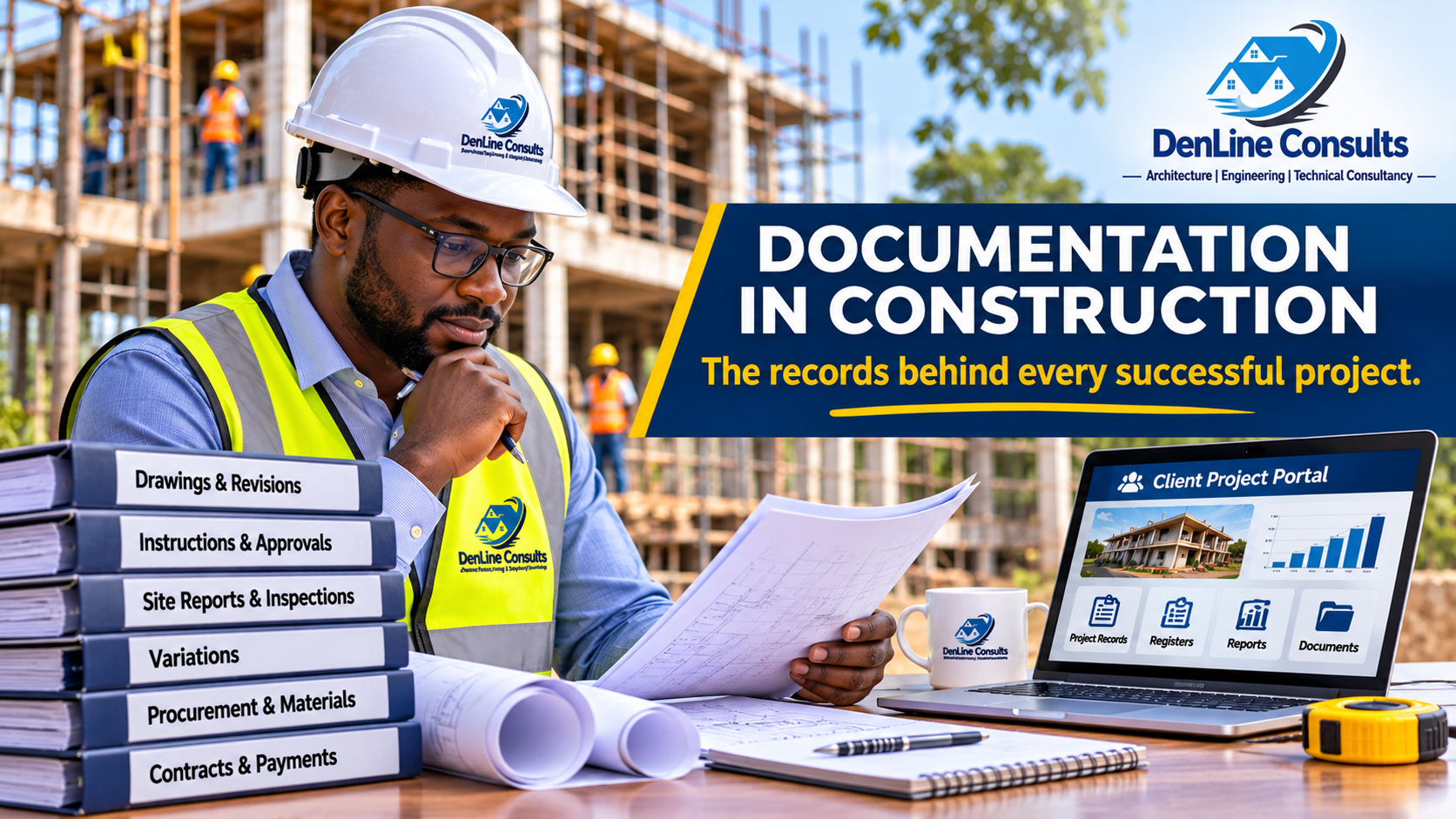
A construction project is much more than the physical process of putting together materials to create a building. Behind every completed structure is a sequence of decisions, instructions, transactions, inspections, approvals and activities that collectively determine how the project is delivered.
Yet, one important aspect of construction management is frequently overlooked: documentation.
Drawings are prepared, materials are procured, contractors are appointed, payments are made, instructions are issued and work progresses on site. But how much of this activity is properly recorded? Can the project owner establish what was agreed, what was approved, what was delivered, what was paid for and whether the work was executed as required?
These questions become particularly important when disagreements arise, costs increase, personnel change or defects are discovered.
Proper documentation is not simply about keeping files. It is about creating a reliable record of the project, supporting informed decisions and ensuring that important activities can be traced, verified and accounted for.
In construction, what is not properly documented can be difficult to verify, manage or defend.
1. Establishing a Reliable Record of the Project
Construction projects involve numerous activities and decisions over an extended period. Without proper documentation, it becomes difficult to maintain a consistent account of how the project has evolved.
Consider a situation where a client requests a change to the original building design. The contractor proceeds with the modification following a verbal discussion. Several weeks later, disagreement arises over the scope of the change, its cost and who authorised it.
Without a written instruction, an agreed variation or another reliable record, establishing the circumstances surrounding the change may be difficult.
This illustrates the importance of maintaining records of significant project activities, including:
- Approved drawings and design revisions.
- Contracts and agreed scopes of work.
- Instructions and technical clarifications.
- Meeting minutes and agreed action points.
- Site inspection and progress reports.
- Material procurement and delivery records.
- Payment assessments and supporting documentation.
- Variations and approvals.
- Testing, commissioning and handover records.
Together, these documents provide a history of the project and help establish what was intended, agreed, executed and recorded at different stages.
2. Documentation and Construction Cost Control
One of the most important applications of construction documentation is financial management.
Construction expenditure is generated through several activities, including procurement, labour, plant, subcontracting, variations and payments to contractors and suppliers.
Without supporting records, it becomes difficult to establish whether expenditure is justified, whether payments correspond to work completed or whether additional costs have been properly authorised.
For example, a purchase invoice alone may not establish that the materials were delivered to the project site, received in the required quantities or utilised for the intended purpose.
Similarly, a payment record may confirm that money was transferred, but it does not necessarily establish that the corresponding work was properly completed or certified.
A properly documented financial process should therefore be supported by relevant records such as:
- Approved budgets and bills of quantities.
- Purchase orders and supplier quotations.
- Delivery notes and goods received records.
- Invoices and payment vouchers.
- Measurement sheets and valuation records.
- Interim payment certificates, where applicable.
- Variation assessments and approvals.
- Expenditure summaries and financial reports.
These records help create a traceable relationship between project requirements, commitments, actual expenditure and work delivered.
For property owners and developers, this is particularly important because financial control should not depend solely on the amount of money spent. It should also consider what was purchased, why it was purchased, what was received and how the expenditure relates to the approved project scope and budget.
3. Protecting the Project Against Disputes and Misunderstandings
Disagreements are not uncommon in construction. They may arise between clients and contractors, consultants and contractors, suppliers and clients, or among members of the project team.
Some disputes concern the interpretation of contractual obligations. Others relate to delayed activities, additional works, defective workmanship, payment entitlements or responsibility for particular decisions.
Proper documentation helps reduce uncertainty by providing records that can be referred to when questions arise.
For instance:
Instructions: Written instructions help establish what was communicated, by whom and when.
Variations: Properly recorded variations help identify changes to the original scope and their potential cost and programme implications.
Progress: Site reports and progress records help establish the status of activities at particular points in time.
Quality: Inspection reports, test results and records of corrective works help demonstrate how quality-related matters were identified and addressed.
Meetings: Proper minutes help record discussions, decisions, responsibilities and agreed actions.
Documentation does not automatically prevent disputes or guarantee a particular outcome in a contractual disagreement. However, accurate and contemporaneous records can significantly improve clarity and assist the parties in establishing the facts.
4. Quality Assurance and Technical Accountability
Quality in construction is not established merely by observing that a building looks complete.
The quality of a project depends on whether the works have been executed in accordance with the applicable drawings, specifications, standards and contractual requirements.
Many important construction activities also become concealed as work progresses. Reinforcement may be covered by concrete, service installations may be enclosed within walls and foundations may become inaccessible after backfilling.
This makes timely inspection and documentation particularly important.
Relevant quality records may include:
- Inspection requests and inspection reports.
- Concrete delivery and test records.
- Reinforcement inspection records.
- Material approval documents.
- Structural and other technical test results.
- Non-conformance reports.
- Records of corrective and remedial works.
- Commissioning and testing certificates.
For example, photographs of reinforcement before concrete placement can provide useful supporting evidence of the condition of the work at the time of inspection. However, photographs should complement, not replace, the required professional inspection and formal records.
Proper quality documentation helps the project team monitor compliance, identify recurring problems and establish whether corrective actions have been undertaken.
5. Keeping the Project Team Coordinated
A construction project rarely depends on one individual. It requires different professionals and organisations to work together, often with different responsibilities and areas of expertise.
An architect may issue revised drawings, a structural engineer may provide technical clarification, a quantity surveyor may assess the financial implications of a proposed change, and the contractor may be responsible for executing the approved works.
If these activities are not properly communicated and recorded, coordination becomes difficult.
For example, a contractor may continue working with an outdated drawing because the revised version was shared informally with only part of the project team. This can result in rework, delays and unnecessary expenditure.
A well-organised documentation system should therefore provide for:
- Clear identification of documents and their revisions.
- Proper distribution of approved drawings and instructions.
- Recording of important project decisions.
- Assignment and tracking of action points.
- Identification of responsible persons.
- Retention of relevant correspondence and approvals.
The objective is to ensure that the people involved in the project are working with the appropriate information and that important decisions are not lost in fragmented communication.
6. Documentation and Project Continuity
Construction projects can extend over months or years. During that period, project personnel may change, consultants may be replaced, contractors may engage new representatives and client representatives may become unavailable.
When project knowledge exists mainly in the memories, personal files or informal conversations of particular individuals, continuity becomes vulnerable.
A properly maintained project record provides a reference point for new personnel and helps them understand the project’s history, current status, outstanding matters and previous decisions.
This is particularly important when taking over an existing project, investigating defects, assessing outstanding works or reviewing previous expenditure.
Project continuity should not depend entirely on the availability of the individual who participated in every previous discussion. Important project information should be maintained in an organised form that authorised personnel can retrieve when required.
7. Documentation Is Particularly Important for Clients Building from Abroad
For clients undertaking construction in Uganda while living overseas, documentation takes on an additional level of importance.
Distance limits the client’s ability to observe construction activities personally. They often depend on reports, photographs, professional advice and information provided by people managing the project locally.
However, receiving occasional updates is not the same as having access to a reliable project record.
A client may need to establish which drawings were approved, whether a particular variation was authorised, what materials were delivered, what progress was reported or how an issue identified during an inspection was addressed.
Without organised documentation, retrieving this information can become frustrating and time-consuming.
A structured project documentation system helps address this challenge by ensuring that relevant records are maintained and made accessible to authorised stakeholders.
For clients abroad, this can improve their ability to follow project developments, understand important decisions and remain informed without having to be physically present at the site.
8. From Paper Files to Digital Project Documentation
Traditionally, construction records have been maintained through printed documents, physical registers, filing cabinets and individual spreadsheets.
These methods can still serve important purposes, particularly where original signed documents and formal records must be retained. However, relying exclusively on fragmented physical and personal records can make information difficult to retrieve, update and share.
Digital documentation offers an opportunity to improve how project information is organised and managed.
A digital project management system can bring together important records such as:
- Project dashboards and progress information.
- Procurement and materials registers.
- Risk and issue registers.
- Variation registers.
- Programme and activity records.
- Inspection and progress reports.
- Approved project documents.
When properly configured and maintained, such a system can improve accessibility, consistency and coordination.
It is equally important to implement appropriate controls. Not every project participant should have unrestricted access to every record. Documents should be managed according to their approval status, confidentiality and the responsibilities of the individuals accessing them.
Digital systems should also provide appropriate document version control, backups and safeguards against unauthorised access or accidental alteration.
Technology does not eliminate the need for proper documentation procedures. Rather, it provides tools through which those procedures can be implemented more effectively.
9. Good Documentation Begins with Good Project Management
It is important to recognise that documentation does not manage a construction project by itself.
A filing system filled with incomplete records, outdated drawings and unverified reports does not necessarily indicate effective project management.
The quality of project documentation depends on the processes through which information is generated, reviewed, approved, maintained and retrieved.
This requires clearly defined responsibilities and consistent management practices.
The project team should understand:
- What information must be recorded.
- Who is responsible for preparing each record.
- Who is authorised to review or approve it.
- Where the information should be stored.
- How revisions and changes should be controlled.
- Who should have access to particular records.
- How long records should be retained.
These arrangements should be established with consideration for the project’s size, complexity, contractual requirements and applicable professional obligations.
At Denline Consults Limited, we recognise documentation as an integral part of effective project management, quantity surveying and construction management. It supports our approach to project coordination, monitoring, reporting and accountability.
Through our digital project management platform, including the Client Project Portal, we also provide authorised clients and stakeholders with controlled access to permitted project information, including relevant dashboards, registers and reports.
This helps extend organised project information beyond the internal management team while maintaining appropriate access controls.
10. What Should Property Owners and Developers Expect?
When engaging professionals to manage or supervise a construction project, property owners should consider not only the activities those professionals will undertake, but also how the work and its outcomes will be documented.
A properly managed project should have an appropriate documentation framework that addresses its technical, financial, contractual and administrative requirements.
Before construction begins, consider asking:
- How will approved drawings and subsequent revisions be controlled?
- How will instructions, decisions and variations be recorded?
- How will site progress and quality inspections be documented?
- How will procurement and expenditure be supported by records?
- How will project risks and outstanding issues be monitored?
- How will important reports and project documents be stored?
- Who will have access to the records, and under what conditions?
These questions help establish whether the project has a practical approach to information management and accountability.
The appropriate documentation requirements will vary from one project to another, but the underlying principle remains the same: important project activities should leave a clear, reliable and retrievable record.
Conclusion: If It Matters, Document It
Construction involves significant financial commitments, technical decisions and contractual responsibilities. Managing these effectively requires more than physical supervision and occasional progress updates.
It requires reliable documentation.
Proper project records support cost control, quality assurance, coordination, accountability, continuity and the resolution of disagreements. They help property owners understand what is happening, professionals make informed decisions and project teams maintain a consistent record of their activities.
Documentation should therefore not be treated as an administrative burden to be addressed after the actual construction work. It is part of the construction management process itself.
At Denline Consults Limited, we believe that a well-managed construction project should be supported by competent professionals, systematic project controls and properly organised information.
Whether you are constructing a residential home, developing commercial property or managing a project remotely from abroad, ensure that your investment is supported by more than physical progress.
Build with a plan. Manage with discipline. Document every important step.
Engage Denline Consults Limited.
Architecture | Engineering | Technical Consultancy
Visit www.denlineconsults.com to learn more about our services.
Leave a Reply