
Construction is a significant investment. Whether you are building a family home, developing commercial property or undertaking a major infrastructure project, the expectation is that the resources committed will translate into a completed development that meets the intended objectives.
Yet, many construction projects encounter difficulties that go beyond the actual construction work. Costs increase unexpectedly, programmes fall behind, defects emerge, decisions are delayed and disagreements arise over what has been done, what remains outstanding and how resources have been utilised.
In many cases, the problem is not simply a shortage of money, materials or technical expertise. It is a gap in project visibility, coordination, information management and professional oversight.
A project may appear to be progressing on site while important management issues remain unnoticed. Work may be advancing, but are costs being controlled? Are activities following the approved programme? Are materials being properly accounted for? Are decisions documented? Can the client independently establish the actual status of the project?
These questions highlight an important principle: building a project is not enough; it must also be properly managed, monitored and controlled.
1. The Visibility Gap: Knowing What Is Happening on Your Project
One of the most common challenges faced by property owners and developers is obtaining a reliable picture of what is happening on their projects.
A contractor may provide photographs, verbal updates or periodic progress reports. While these are useful, they do not necessarily provide a complete picture of project performance.
For example, photographs may demonstrate that a particular activity has taken place, but they may not establish whether the work complies with approved drawings, specifications or contractual requirements. A reported percentage of completion may not necessarily reflect the actual progress of the project against its programme. Similarly, materials delivered to site do not automatically establish that procurement has been economical or that the materials have been properly utilised.
Effective project visibility therefore requires more than receiving updates. It requires organised information, professional verification and a clear understanding of project performance.
Property owners should be able to establish:
- What activities have been completed and what remains outstanding?
- Is the project progressing according to the approved programme?
- Are the works being executed in accordance with the relevant designs and specifications?
- What issues, risks or constraints require attention?
- What decisions are required from the client?
- Are project resources being managed appropriately?
Without reliable answers, the client is effectively managing a major investment with incomplete information.
2. When Project Information Is Scattered, Control Becomes Difficult
Modern construction projects involve several parties. These may include the client, architect, engineers, quantity surveyor, project manager, contractor, subcontractors and suppliers.
Each party contributes information and makes decisions within their respective responsibilities. Drawings, instructions, meeting minutes, progress reports, procurement records, inspection reports and other documents are generated throughout the project.
The difficulty arises when these records are scattered across different communication channels and storage locations.
Important information may exist in email conversations, WhatsApp groups, individual computers, printed documents or personal filing systems. A document may be revised without all relevant parties receiving the updated version. A decision made during a telephone conversation may never be formally recorded. A register maintained by one professional may not be accessible to another person who needs the information.
The consequences can include:
- Difficulty retrieving important project records.
- Confusion over the latest approved drawings or instructions.
- Repetition of discussions and decisions.
- Delays arising from missing or incomplete information.
- Poor continuity when project personnel change.
- Disagreements over decisions, responsibilities and previous communications.
A well-managed project requires more than generating documents. It requires a deliberate approach to organising, maintaining, updating and accessing project information.
Document control and information management are therefore not merely administrative activities. They are important components of effective construction project management.
3. The Cost of Inadequate Monitoring and Oversight
Construction projects involve interconnected activities. A problem in one area can affect several others.
For example, delayed decisions may interrupt procurement. Late procurement may affect the construction programme. Poor coordination between design and construction teams may result in rework. Inadequate inspection may allow defects to progress to subsequent stages, making rectification more difficult and expensive.
The earlier such issues are identified, the greater the opportunity to address them before they escalate.
Consider some common project management challenges:
Cost overruns: Without proper cost monitoring, variations, additional works, wastage and unplanned expenditure may accumulate without the client having a clear understanding of their financial implications.
Programme delays: Without consistent monitoring against an approved programme, delays may only become apparent when they have already affected important milestones.
Poor workmanship: Inadequate inspection and supervision may allow work that does not meet the required standards to proceed to subsequent construction stages.
Procurement inefficiencies: Poor coordination between the construction programme, material requirements and procurement activities can result in shortages, unnecessary purchases, delays and wastage.
Uncontrolled variations: Changes to the original scope, drawings or specifications can have significant cost and time implications when they are not properly assessed, authorised and documented.
These challenges demonstrate why construction monitoring must be systematic. It should not depend entirely on occasional visits, informal updates or the ability of the client to identify problems personally.
4. Monitoring Is Not the Same as Receiving Progress Reports
Progress reports are essential management tools. They communicate the status of a project, record developments and highlight matters requiring attention.
However, a report is only as reliable as the processes through which its information is collected, verified, analysed and presented.
Effective monitoring involves comparing actual performance against established project objectives and requirements.
For example:
- Physical progress should be assessed against the approved construction programme.
- Workmanship should be inspected against the relevant drawings, specifications and applicable standards.
- Expenditure should be evaluated against the approved budget and relevant financial records.
- Procurement should be monitored against project requirements and approved material specifications.
- Variations should be identified, assessed and properly documented.
- Risks and outstanding issues should be recorded and followed through to resolution.
This requires clearly defined professional responsibilities and an organised reporting structure.
A site visit may reveal the physical state of a project, but effective project monitoring goes further. It considers what has happened, why it has happened, what it means for the project and what action may be necessary.
The objective is not simply to report activity. It is to support informed decisions and maintain control over project performance.
5. The Importance of Properly Organised Project Records
A well-managed construction project should have a reliable record of its activities, decisions and performance.
Depending on the nature and complexity of the project, important records may include:
- Construction programmes and progress updates.
- Site inspection and supervision reports.
- Requests for information and technical clarifications.
- Drawing and document registers.
- Procurement and materials registers.
- Variation registers.
- Risk and issue registers.
- Meeting minutes and action registers.
- Instructions and approvals.
- Payment assessments and financial reports.
- Defects and outstanding works registers.
These records serve different purposes, but collectively they provide an important account of how the project is being managed.
For instance, a procurement register helps track materials required, ordered, delivered and accounted for. A variation register provides a record of changes to the original scope and their associated implications. A risk register helps the project team identify potential problems, assign responsibilities and monitor mitigation measures.
Dashboards can further consolidate relevant information, making it easier to understand project status without having to review numerous separate records.
The value of these tools lies not merely in their existence, but in their consistent maintenance and use by the project team.
6. Technology Is Changing How Construction Projects Are Managed
As construction projects become increasingly complex, technology presents opportunities to improve how project information is organised, managed and accessed.
Digital project management systems can bring together information that would otherwise be maintained in separate files and records. They can help project teams maintain registers, monitor activities, generate reports and provide authorised stakeholders with access to relevant project information.
For property owners, this introduces an important improvement: access to organised project information without having to depend entirely on periodic document sharing.
For consultants and project managers, it provides a structured environment for maintaining project records and coordinating management activities.
However, technology should be understood as an instrument of project management, not a substitute for professional judgement.
A dashboard cannot independently establish whether concrete has achieved the required strength. A digital register cannot replace a competent inspection. An automated report cannot compensate for inaccurate information or inadequate professional oversight.
Technology delivers value when it supports sound management processes, reliable information and competent professionals.
7. What About Clients Managing Construction from Abroad?
The visibility gap becomes particularly important when the property owner is not physically present at the construction site.
For Ugandans living abroad and other investors undertaking construction in Uganda, distance introduces additional challenges.
They may depend on contractors, relatives, site representatives or other individuals to provide updates. They may receive photographs without sufficient technical context or struggle to retrieve previous reports and project documents when making important decisions.
Even where a client has engaged competent professionals, the absence of a convenient and organised information system can make it difficult to follow developments throughout the project.
Effective remote project management therefore requires more than sending photographs and occasional updates.
It requires clearly defined professional responsibilities, structured reporting, appropriate verification, reliable records and convenient access to relevant project information.
Clients should be able to remain informed and involved without having to be physically present for every project activity.
This is not about replacing professional site supervision or direct communication. It is about strengthening the systems through which project information is maintained and made available to the people who need it.
8. A More Connected Approach to Project Management
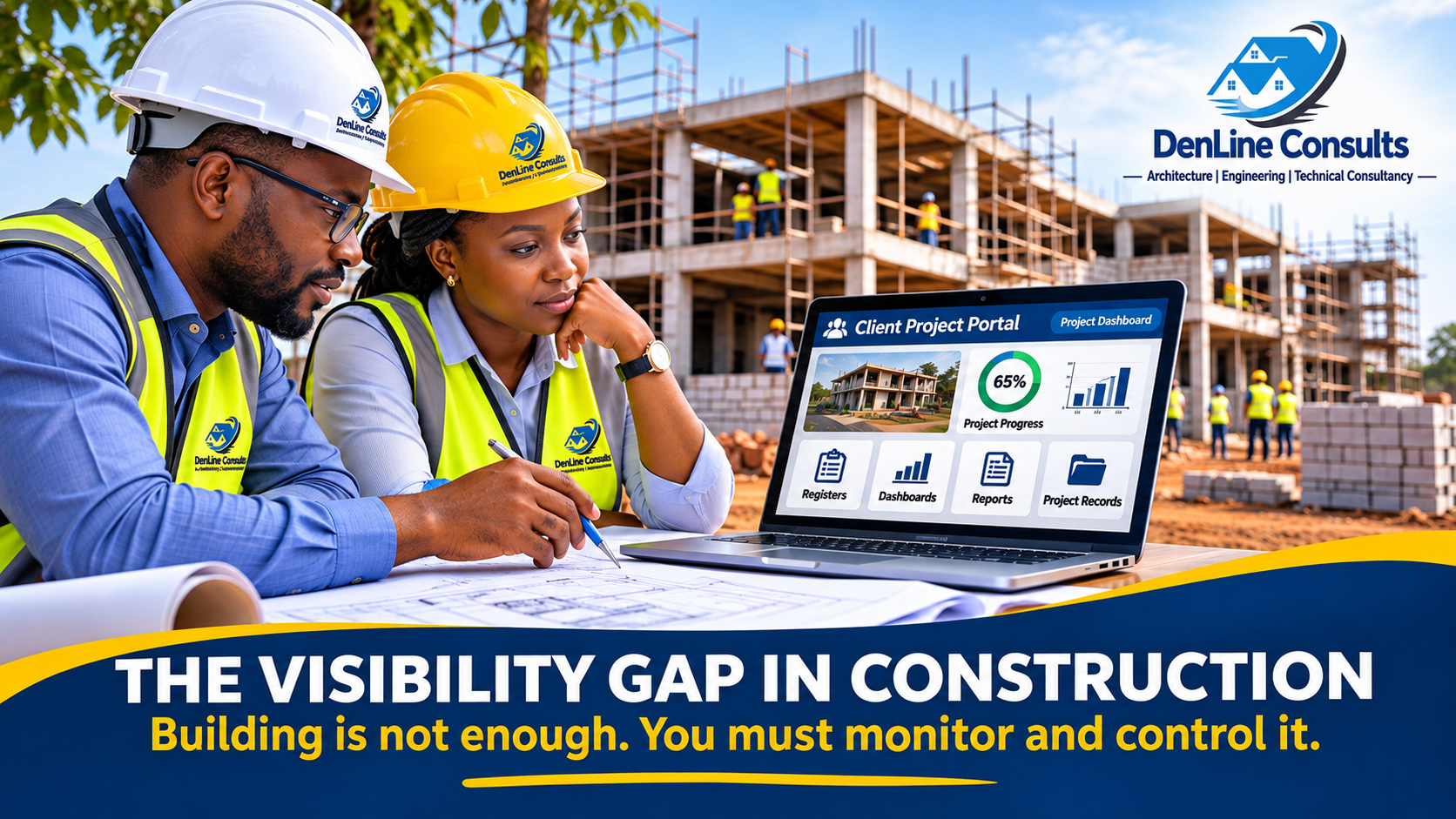
Recognising the importance of organised project information and client visibility, Denline Consults Limited has expanded its digital project management platform to include a dedicated client and stakeholder access facility.
Introducing Denline Client Project Portal.
The Client Project Portal forms part of Denline’s approach to providing structured, technology-enabled project management services.
Through the platform, authorised clients and other approved stakeholders can access information relating specifically to the projects to which they have been assigned.
Depending on their access permissions, users can view relevant project information, including:
Project dashboards: Consolidated views of relevant project status and performance information.
Project registers: Access to permitted registers maintained as part of the project’s management and control processes.
Project reports: Access to approved reports that communicate project developments and provide a record of relevant management activities.
Project records and documents: Access to relevant information made available to the stakeholder in accordance with their assigned permissions.
Importantly, access is controlled at project level. A stakeholder is only able to view the project information they have been authorised to access.
The platform is designed to improve information accessibility and provide clients with a more organised way of following their projects. Formal financial summaries remain communicated through the relevant project reports, while direct communication and queries continue through the established channels used by the project team.
This approach recognises that effective project management is not only about what happens on site. It is also about how information is organised, maintained and made accessible throughout the project.
9. Why Professional Project Management Still Matters
Digital systems are valuable, but they do not manage construction projects on their own.
A successful construction project requires coordination of technical, financial, contractual, procurement and administrative activities.
It requires professionals who can interpret project requirements, assess progress, identify emerging risks, evaluate cost implications, coordinate the relevant parties and provide informed advice to the client.
The appropriate professional team and scope of appointment will depend on the nature and complexity of the project. Nevertheless, clear responsibilities and effective coordination are essential.
For property owners and developers, engaging competent professional support can help establish the management structures required to monitor performance and make informed decisions.
At Denline Consults Limited, our approach to construction consultancy recognises the relationship between professional expertise, systematic project controls and organised information management.
Our services include quantity surveying, project management, construction management, architectural and engineering consultancy, and related technical services.
Through the appropriate combination of these services, we support clients in planning, coordinating, monitoring and managing their construction investments.
Project Connect strengthens this approach by extending controlled access to relevant project information beyond the internal project team.
10. Before You Build, Consider How You Will Manage Your Project
When planning a construction project, much attention is understandably given to architectural design, construction costs, materials and contractor selection.
However, an equally important question is often overlooked:
How will you know whether your project is being properly managed once construction begins?
Before committing significant resources, consider the following:
- Have you established a realistic project budget and construction programme?
- Have you clearly defined the responsibilities of the professionals and contractor?
- Is there an appropriate system for monitoring progress, quality, costs and procurement?
- Are project decisions, instructions and variations properly documented?
- Are important project records maintained in an organised and accessible manner?
- Will you receive reliable, meaningful progress reports?
- Can authorised stakeholders access the project information they need?
- Is there a clear process for identifying, reporting and addressing risks and defects?
These are not merely administrative considerations. They are fundamental questions about protecting your investment and achieving the intended project outcomes.
Conclusion: Visibility Is Part of Control
A construction project should never become a situation in which the client commits substantial resources but remains uncertain about what is happening, how decisions are being made or whether the project is progressing as intended.
Effective construction management requires planning, coordination, professional oversight, cost control, monitoring, documentation and accountability.
It also requires reliable systems through which project information can be maintained and accessed by the appropriate people.
At Denline Consults Limited, we believe that clients deserve a more structured and informed construction experience. Our professional services, supported by digital project management tools such as Denline Project Connect, are intended to strengthen project visibility, improve information management and support better-informed decisions throughout the construction process.
Whether you are developing a residential property, undertaking a commercial project or investing in construction in Uganda from abroad, the management of your project deserves as much attention as its design and construction.
Do not simply build. Plan, monitor and manage your investment.
Engage Denline Consults Limited.
Your vision. Our expertise. A better-managed construction journey.
Visit www.denlineconsults.com to learn more about our services and how we can support your next construction project.
Leave a Reply